
Bioavailability, Cofactors, Label Reading
What Are Whole Food Supplements? A Formulator Explains the Difference

The short answer
A whole food supplement is exactly what it sounds like. The nutrients come from real, natural foods (fruits, vegetables, herbs, organ meats, botanicals) and they stay in their original food matrix. Nothing is stripped out. Nothing is synthesized. The vitamins, minerals, enzymes, and cofactors remain together, the way they exist in nature.
When you look at the label of a whole food supplement, you see food names. Beet root. Nutritional yeast. Liver. Camu. Broccoli. Carrot. These aren't flavoring agents. They ARE the foods in the supplement.
How most supplements are actually made
To understand what makes whole food supplements different, it helps to know what's in most bottles on the shelf.
There are two main categories you'll run into.
Synthetic vitamins are chemical isolates manufactured in a lab. For example, most vitamin C supplements are ascorbic acid produced through a process that begins with corn syrup. Most B vitamins on the market come from processes involving coal tar derivatives. Vitamin A palmitate, niacinamide, pyridoxine hydrochloride? These are laboratory-made compounds designed to mimic what's found in food. Your body recognizes the difference.
"Natural" vitamins sound better, and the marketing certainly wants you to believe they are. These are nutrients extracted from a food source so that they are isolated from the rest of the naturally occurring food complex. You end up with a single compound in a bottle. It may have come from food originally, but by the time it reaches you, it's been separated from everything that helped it work. So it's basically just a chemical. Definitely not a food.
Both approaches share the same problem: they deliver a singular chemical alone, without its supporting cast.
Whole Food vs. Food-Based vs. Synthetic: A Comparison
This is the table my first mentor showed me 30 years ago. Three categories that look similar on the shelf but are fundamentally different.
| Whole Food | Food-Based | Synthetic | |
|---|---|---|---|
| Source | Nature's real foods (fruits, vegetables, herbs, organ meats) | Synthetic vitamins added to a yeast or food base during manufacturing | Chemical compounds manufactured in a laboratory |
| How it's made | Foods are dried and either tableted, encapsulated, or powdered; nutrients remain in their original food matrix | Synthetic vitamins are fed to yeast or blended with food powders; the vitamin started as a chemical | Produced from industrial processes (e.g., corn syrup for ascorbic acid, coal tar for B vitamins) |
| What's on the label | Food names: beet root, nutritional yeast, liver, camu | Mix of food names and chemical names, or vague terms like "food-cultured" or even "natural" | Chemical names: ascorbic acid, pyridoxine HCl, cyanocobalamin |
| Cofactors present? | Yes — naturally occurring enzymes, bioflavonoids, trace minerals intact | Some food compounds present, but the primary vitamin was added as an isolated chemical | No — isolated compound only |
| Body recognition | Recognized and processed as food | Partially recognized; the added vitamin is still a synthetic molecule | Processed as a chemical; body must supply its own cofactors |
| Example | Camu provided for vitamin C, with bioflavonoids intact | Synthetic ascorbic acid grown in yeast culture, marketed as "food-grown vitamin C" | Ascorbic acid tablet, 1,000 mg |
The "Food-Based" Label Trick
This is something I want you to know about, because almost nobody explains it truthfully.
Some supplement companies take a synthetic vitamin — a chemical isolate made in a laboratory to resemble a real vitamin — and add it to a yeast culture or a food base during manufacturing. The yeast metabolizes the synthetic vitamin. The company then markets the result as "food-based," "food-grown," or even "whole food." Very misleading.
The vitamin started as a chemical. It went through a process. And now it has a friendlier label.
I'm not saying these companies are doing something illegal. They're not. But I am saying the label creates a misleading impression. When most people read "food-based" or "whole food" on a supplement bottle, they assume the nutrients come from food. In many cases, they don't. They come from a lab and are introduced to food during production.
Here's how to tell the difference. Look at the Supplement Facts panel. If you see a vitamin listed with a precise, high milligram dose — say, 500 mg of vitamin C — alongside a food like "organic citrus blend" listed lower on the panel, that vitamin was almost certainly added. Foods don't deliver nutrients in such precise, uniform doses. Even two identically sized carrots provide a different nutrient profile. A genuine whole food supplement lists the food itself as the source, and the nutrients present are whatever the food naturally contains.
The distinction matters because the whole point of a whole food supplement is that the nutrient was never separated from its food matrix. If it started in a lab and was introduced to food afterward, you've lost that advantage. Your body's biochemistry recognizes the difference.

Why cofactors matter
This is the concept at the foundation of every formula I've ever made.
Nutrients don't work alone. In nature, every vitamin exists inside a complex, a group of related compounds that work together. Vitamin C isn't just ascorbic acid. In food, it comes bundled with bioflavonoids, tyrosinase, rutin, and other factors that help your body absorb and use it. Take the ascorbic acid by itself and at best you've got a fraction of the picture. At worst your body has to work harder to process it.
The same is true for B vitamins, minerals, and fat-soluble vitamins. Each one exists in nature as part of a team. These supporting compounds are called cofactors, and they're what make the difference between a nutrient your body can use efficiently and one it has to work around.
When you consume an isolated vitamin, your body has to pull cofactors from its own reserves to process that nutrient. You're borrowing from Peter to pay Paul. With a whole food supplement, the cofactors are naturally built in. The body doesn't have to compensate or figure out how to use or eliminate it.
What the Research Shows About Bioavailability
This is worth addressing, because it comes up often.
The research on food-form nutrients versus synthetic isolates is still developing. There are studies showing that nutrients delivered within a food matrix have different absorption profiles and benefits than isolated nutrients. Research shows that nutrients from whole foods support absorption, metabolism, and biological function in ways isolated or synthetic versions may not fully replicate.
What I can tell you, after three decades of clinical practice, is that the science is now revealing what practitioners have observed for decades. The clients I've worked with respond differently to whole food supplements than they do to synthetic isolates, and that difference is consistent and crucial.
The honest answer is this: we don't have a single, definitive study that settles the question for every food in nature. But the principle — that nutrients work best in the context they naturally occur — is supported by a growing body of research as well as a million years of human evolution related to diet. And it's consistent with everything we know about how the body processes food.
Your body was designed to get nutrition from food. That much isn't controversial.

The orchestra vs. the single instrument
I use this analogy with my clients all the time.
Imagine you're listening to a full orchestra. Every instrument has a role. The violins carry the melody, but the cellos give it depth. The woodwinds add color. The percussion keeps everything anchored and in rhythm. Together, they create something that no single instrument could produce on its own — a holistic, concerted masterpiece.
Now imagine someone hands you a recording of just the first violin, playing its part alone. Technically, you're hearing the melody. But you're missing every other instrument that supported it to make the performance wondrous.
That's the difference between an isolated vitamin and a whole food supplement. The isolated version gives you one note. The whole food version gives you the entire composition.

What to look for on the label
This is the most practical thing I can pass along, and it takes about 30 seconds at the store.
Flip the bottle over and read the ingredients.
If you see chemical names (ascorbic acid, thiamine mononitrate, dl-alpha tocopherol, calcium carbonate, cyanocobalamin) you're looking at isolated or synthetic nutrients. These are laboratory-made compounds, regardless of what the front of the bottle says.
If you see food names (beet root, carrot, nutritional yeast, liver, mushroom, alfalfa, camu) you're looking at whole food ingredients. The naturally occurring nutrients are still inside the food.
One more thing to watch for: some brands list food names alongside chemical names. They'll blend a small amount of a food powder in with a large dose of a synthetic vitamin and call it "whole food based" or "food derived." Read the full ingredient list. If chemical names dominate, it's an isolated supplement with some food powder sprinkled in.
If the ingredient list reads like a grocery list, you're on the right track. If it reads like a chemistry textbook, you're looking at isolates.
Why milligrams don't tell the whole story
This is where people get confused, and I understand why.
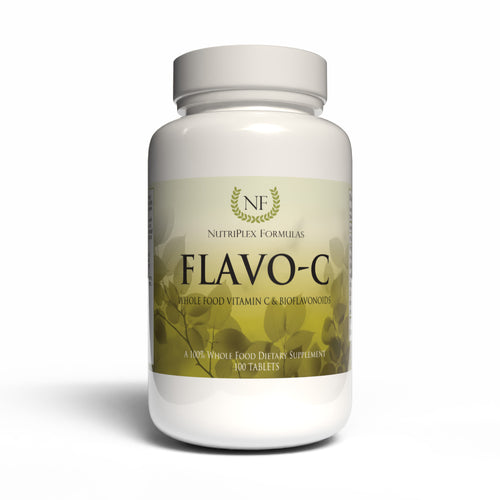
You pick up a conventional vitamin C supplement and it says 1,000 mg. You pick up a whole food like an acerola cherry, contained in Flavo-C, and the milligram count of vitamin C is only 15%. So the conventional one must be better because it's higher, right?
Not exactly.
That 1,000 mg of ascorbic acid is a single isolated compound. None of nature's foods provide this much vitamin C. And this should alert you as to why. Your body has to figure out what to do with a large dose of one chemical. Much of it passes through without being used. Some of it can cause side effects.
The whole food version delivers vitamin C as part of the complete complex, with bioflavonoids, enzymes, and cofactors intact. Your body recognizes it as food and absorbs it more efficiently. You need less because the vitamin C isn't the most important thing to consider. It's the food complex that contains all the helper nutrients.
Milligrams measure quantity. This is how pharmacology works. But foods aren't drugs, they are... well, foods!
How our formulas came about
I started formulating these supplements for my clinical nutrition practice. My clients needed products I could trust. Supplements made from real foods, with no additives or synthetic vitamins, where I knew exactly what was going into every tablet.
I couldn't find them on the market. So I made them after some considerable practice and research.
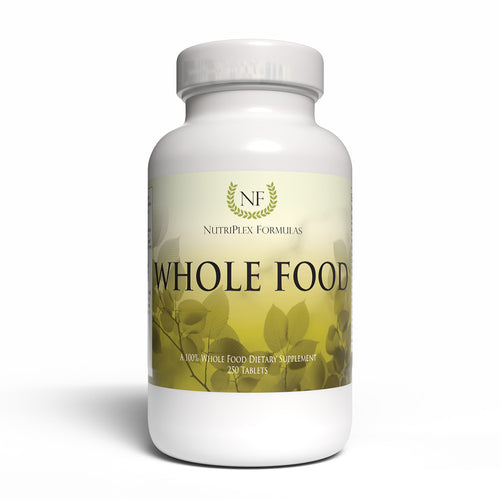
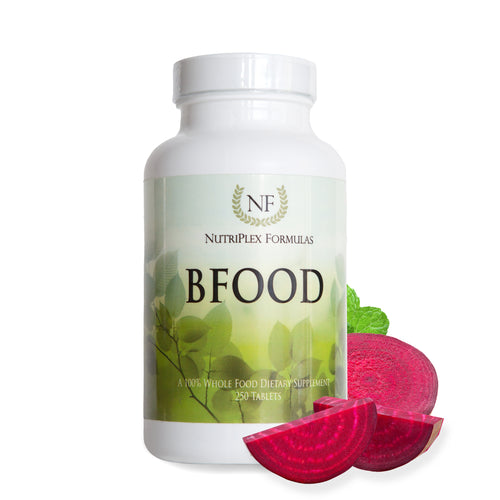
Over the past three decades, the result of my effort became Whole Food Formulas. We offer 13 whole food supplements, each one formulated from organically grown, nutrient-dense foods. Whole Food is our whole food multi-vitamin, real foods presented in tablet form. BFood is our whole food B vitamin complex, made from nutritional yeast, liver, and other B-rich foods instead of coal tar derivatives. Flavo-C delivers the full vitamin C complex with bioflavonoids from camu and acerola cherry, rather than isolated ascorbic acid.
Every product in our whole food line follows the same principle: Adrenal Support, Immune Support, Green Nutrients, Cardio Food, Super Greens, Caro-C, InflaPlex, ProMin, Blood Sugar Balance, and Detox and Cleanse. Real foods. Complete complexes. No isolates or synthetics.
Who whole food supplements are for
Anyone who wants their nutrition to come from food rather than a chemistry lab. If you're supporting your daily diet, looking after a specific area of health, or just want to know that what you're putting in your body is real food, this is what we make.
One thing I always tell people: be patient. Real, natural healing is a bodily process that takes time. You feed your body the needed nutrients and then nature takes its course. Some people notice a difference within days. For others, it's a process of building health over weeks and months.
The best advice I can offer is simple: take the supplements consistently, and see how your body feels.
Frequently Asked Questions
Are whole food supplements better than synthetic vitamins?
Whole food supplements deliver nutrients in their complete food complex, with cofactors intact. Your body can absorb and use them more efficiently than isolated synthetic compounds. Eating camu from the Amazon rainforest gives you the full vitamin C complex. Taking a pill of ascorbic acid from a laboratory gives you one artificial piece of it.
Why is the milligram count lower on whole food supplements?
Milligrams measure the weight of a compound, not how well your body uses it or the important helper nutrients in a food. Whole food supplements include the full nutrient complex, so your body absorbs more of what you take and receives a full complement of nutrients other than a single vitamin or mineral. A lower milligram dose with high bioavailability found in a whole, natural food provides your body more than a large dose of an isolated chemical.
How do I know if a supplement is really whole food?
Read the ingredient list. If you see food names (beet root, carrot, liver, nutritional yeast, camu) those are whole food ingredients. If you see chemical names like ascorbic acid, mixed tocopherols, pyridoxine HCl, or vitamin A palmitate, you're looking at isolates or synthetics, no matter what the front label says about foods or food-based.
What does "food-based" mean on a supplement label?
It depends on who made it. Many companies use "food-based" to describe synthetic vitamins that were added to a yeast culture or food powder during manufacturing. The vitamin started in a laboratory and was introduced to a food base afterward. This is different from a genuine whole food supplement, where the nutrients come from plants grown in rich soil under the sun and were never separated from the food they came from. Check the Supplement Facts panel. If you see high-dose vitamins listed alongside small amounts of food powders, the vitamins were likely added, not naturally present.
Are whole food supplements FDA-approved?
No dietary supplement is FDA-approved. The FDA does not evaluate supplements the way it evaluates pharmaceutical drugs. What the FDA does require is that supplement companies follow Good Manufacturing Practices and that all claims are structure/function claims, not disease claims. Our supplements are manufactured in an FDA- and GMP-compliant facility.
Can I take whole food supplements with medications?
If you're on prescription medication, it's a good idea to check with a healthcare practitioner who understands nutrition before adding any supplement to your routine. Whole food supplements are food in tablet, capsule, or powder form, so they're generally well-tolerated. But certain nutrients may interact with certain medications, and a practitioner familiar with both can help you make the best decision. Medications serve their own purpose, but they don't provide the nutrients your body needs to build health. The two aren't in conflict.
How long does it take to notice a difference with whole food supplements?
It varies. Some people feel a difference within hours, especially if they've been significantly lacking in certain nutrients. For most people, the changes unfold over weeks and months as the body rebuilds with real nutrition. Consistency matters more than anything.
Do whole food supplements need to be taken with food?
Because whole food supplements are food in tablet form, they're generally easy on the stomach and can be taken with or without a meal. That said, taking them with food is a reasonable approach, especially if you have a sensitive stomach.
Products Mentioned in This Article

These statements have not been evaluated by the Food and Drug Administration. This product is not intended to diagnose, treat, cure, or prevent any disease.