
Acerola Cherry, Ascorbic Acid, Bioflavonoids
Whole Food Vitamin C vs. Ascorbic Acid: What's in Your Supplement?

If you've been taking vitamin C every day and still feel run-down every winter, or you got hit with the iconic summer cold that never seems to make sense, the problem might not necessarily be that you need more vitamin C. It might be that what you're already taking isn't the vitamin C found in real food, but only an isolated version of it.
I've spent more than 30 years studying how nutrients work in the body, and one of the most persistent misconceptions I run into is the idea that an ascorbic acid pill and the vitamin C found within nature's whole foods are the same thing. They’re not at all alike. Vitamin C pills and tablets are sold as being equivalent, but there's a significant difference when you look closer. One is a single isolated chemical manufactured in a lab. The other is a vitamin that nature packages into a group of nutrients in a real food. The natural vitamin still within its food complex exists in a form your body recognizes and can work with far more completely.
It often comes as a surprise to learn that most of the ascorbic acid (what consumers call "vitamin C") sold throughout the world is produced by a small number of very large chemical manufacturers, not by supplement companies. The various supplement brands purchase bulk ascorbic acid and then encapsulate, tablet, or package it under their own brand names. Today, the overwhelming majority of the world's ascorbic acid is manufactured in China. China is estimated to produce roughly 80–90% of the global supply of vitamin C.
This distinction between real food nutrients and synthetic chemicals matters when you're choosing a supplement, and it especially matters when the label says vitamin C or ester C but the product is not a food. And it especially matters to your body’s molecules and cells!

What Is Vitamin C, Really?
Spend any time reading supplement labels and you'll encounter the term "ascorbic acid" used interchangeably with "vitamin C." This has been standard practice for decades. At best, ascorbic acid is only part of the vitamin C picture. At worst, a supplement’s vitamin C is just a product manufactured by a huge company as a synthetic chemical to act like nature’s vitamin C.
In real food, no vitamin or mineral ever exists alone, in isolation. Nutrients exist within a group of other important nutrients and molecules that help your body absorb them, use them, keep them active, and benefit from them. There is no such thing as a vitamin C bush, but you can find orange, acerola, and lemon trees, berry bushes, and pepper plants. When you separate vitamin C from the naturally occurring cofactors (helper nutrients) that surround it within the plant structure and then you put it in a capsule all by itself, you're left with one artificial chemical. There’s nothing natural about this.
The Vitamin C Complex: What's Contained in Real Food?
In whole foods like camu, acerola cherry, pepper, spinach, rose hips, and other fruits and vegetables, vitamin C is accompanied by a broad range of other nutrients, including bioflavonoids. These include rutin, quercetin, hesperidin, kaempferol, anthocyanins, catechins, and chlorogenic acid, along with smaller amounts of other cofactors.
These nutrients aren't just window dressing. They are important to your health, healing, recovery, and cellular protection. Bioflavonoids help protect vitamin C from oxidation, meaning they slow it from being broken down by exposure to oxygen before your cells can use it. They also support the structure and elasticity of capillaries, the smallest blood vessels in your body, which connects directly to how vitamin C supports tissue repair, skin, and circulation.
One particular area where this matters is collagen. Collagen is sometimes called the "intercellular cement" that holds tissues together, the structural protein in your skin, blood vessel walls, connective tissue, and gums. Vitamin C plays an essential role in collagen synthesis, and many of the bioflavonoids that accompany it within whole foods support connective tissue health in their own right.
The cofactors contained in whole food vitamin C also include minerals, carotenoids, vitamins from the B family, and plant nutrients your body uses across a range of functions. These aren't incidental. They are part of what makes whole food vitamin C significantly different from an isolated chemical that is erroneously said to be the same nutrient.
What Ascorbic Acid Actually Is
Ascorbic acid does both of these critical functions: it protects other ingredients in a supplement from oxidation and it protects the body from oxidation by acting as a powerful antioxidant.
How It Works in Supplements
- Prevents breakdown: It reacts with oxygen before other sensitive ingredients can.
- Saves nutrients: It helps keep vitamins and active parts stable in the bottle.
How It Works in the Body
- Fights free radicals: It stops unstable molecules from damaging your cells.
- Supports other antioxidants: It helps turn used vitamin E back into an active helper.
Here's what I find useful to keep in mind. There's no such thing as a vitamin bush, a niacin tree, an ascorbic acid flower, or a four-legged creature called a "rutin." Vitamins manufactured in a laboratory as isolated chemicals do not exist in nature. Real vitamins exist within foods as complex, cooperative systems. Ascorbic acid, when extracted and produced on its own, or when it is entirely artificial as most vitamin C is, does not function as a natural food system.

How Ascorbic Acid Is Made (And Why It Matters)
Most ascorbic acid sold in supplements today, including many products marketed to health-conscious consumers, is produced through an industrial fermentation process that begins with corn sugar. Through a series of chemical conversion steps, the corn sugar is transformed into ascorbic acid. This is the case even for products labeled “natural,” “non-GMO,” or even organic.
Here is the (simplified) unnatural process to make vitamin C ascorbic acid:
- Corn (or occasionally another starch source) is converted to glucose (sugar).
- The glucose is fermented by microorganisms.
- Additional chemical and catalytic steps convert the intermediates into pure crystalline L-ascorbic acid.
You can see that the end result in the vitamin bottle is far from anything that can be called natural. The "natural" designation refers to the starting material or the absence of certain additives, not to whether the final molecule resembles anything your body would encounter from eating a piece of fruit. The word "natural" is used without responsibility, because there is no way to enforce its use, and the product is usually not really natural at all. Non-GMO labeling tells you about the corn used in the process of manufacturing artificial vitamin C, not about whether the resulting ascorbic acid carries any of the cofactors contained in food.
I'm not saying ascorbic acid produced this way is toxic or without value. It has what might be called a pharmaceutical value; it influences biochemical reactions, but it does not act as a food nutrient in the body. Isolated ascorbic acid is not nutritionally identical to the vitamin C found in whole foods. How can it be? It’s made in a laboratory! A tablet of ascorbic acid is simply not the same as eating an acerola cherry, an apple, a spinach salad, a red pepper, or a handful of camu berries.
The distance between corn sugar and the vitamin C in a berry is not just a manufacturing detail. It's the difference between a single isolated molecule and the nutritional system that molecule operates within in nature.

The Supplement Label Trick: How Lab-Made Vitamin C Gets Labeled "Whole Food"
This is something consumers deserve to understand clearly.
To complicate things further, some supplement companies introduce synthetic ascorbic acid to a food substrate, such as dried yeast cultures or rice bran. They then label the result "whole food vitamin C," "food-grown vitamin C," or "food-sourced vitamin C." This is quite misleading, especially if you have little time or expertise to investigate the science.
The problem is that the ascorbic acid is still synthetic. It did not originate in a whole food and it is not to be found in nature. It was produced industrially and then combined with a food base after the fact. The food substrate is essentially a carrier, not the origin of the vitamin. The bioflavonoid complex, the cofactors, and the plant nutrients that naturally accompany vitamin C in a berry are not present in any meaningful amount from this process.
I've been formulating whole food supplements for a long time, and I understand why some companies do this. It lets them use the language of whole food nutrition while keeping production costs cheap. But your body doesn’t care about the cost. It just wants something that works and doesn’t cause a burden. Synthetic vitamin producers create confusion for people who are trying to make informed choices and do what's best for their health. A label may sound like whole food nutrition, but the underlying ingredient isn't.
Nature's whole foods are natural. This is logical. The vitamin C found in foods is therefore natural. Vitamin C sold as an isolated, synthetic supplement is unnatural. There's no confusion here.
How to Spot an Isolate on a Label
If a supplement label lists ascorbic acid as its source of vitamin C, this refers to a synthetic isolate, regardless of any claims on the label. If the label uses phrases like "food complexed," "food grown," or "naturally complexed," that language usually describes a process of introducing synthetic ascorbic acid to a food substrate, not a product made from whole food plants.
We can use a quick analogy here: When you buy a loaf of bread from the grocery store you will usually find a list of vitamins and minerals, but these nutrients do not come from the bread ingredients such as the flour, salt, butter, and so on. Instead they are added to the mix as isolated chemicals. The same is done with boxed cereal, crackers, and most other processed foods. The food industry uses the word “enriched” to describe this process. Most supplement companies do the same thing, but instead of saying “enriched,” they display the milligrams of the artificial nutrients.
As a consumer it helps to understand that the milligram count of vitamins, minerals, and proteins in a supplement has to do with meeting dietary daily value requirements. The irony, though, is that such requirements do not have to be naturally occurring nutrients. In other words, government standards support artificial vitamins and isolated minerals over nature’s real foods. This is how upside down our world has become, where the artificial is officially accepted as equal to what’s real. Regardless, the human body knows the difference between the two.
Genuine whole food supplements list the actual whole food and not the vitamins and their milligrams. Acerola cherry, camu, and rose hips are the plants that contain the vitamin C complex. If these are listed first, as the actual origin of the vitamin C in your supplement, that's a meaningful difference. If ascorbic acid is the primary ingredient and the whole food appears further down the list in small amounts, it's likely there as decoration.
I'll walk through the specific label signals in more detail below.
Whole Food Vitamin C vs. Ascorbic Acid — Side-by-Side Comparison
| Whole Food Vitamin C | Ascorbic Acid (Synthetic) | |
|---|---|---|
| Source | Whole food plants (acerola, camu camu, rose hips) | Industrial fermentation of corn sugar |
| Active nutrient | Ascorbic acid within a full bioflavonoid complex | Isolated ascorbic acid only |
| Cofactors included | Rutin, quercetin, hesperidin, kaempferol, anthocyanins, catechins, carotenoids, minerals | None (isolated molecule) |
| Bioflavonoid presence | Yes — bioflavonoids are contained in the plant alongside the ascorbic acid | No |
| Copper interaction | Complex intact; some research suggests high-dose isolated ascorbic acid may affect copper levels | High-dose isolated ascorbic acid has been associated with reduced ceruloplasmin activity in some studies |
| Shelf stability | Bioflavonoids help protect ascorbic acid from oxidation | No protective cofactors present, especially because chemicals do not spoil quickly |
| Label signal | Whole food listed first (acerola, camu camu); no isolated ascorbic acid | "Ascorbic acid" or "vitamin C (as ascorbic acid)" as primary listing, especially with a milligram (mg) measurement. |
| Cost | Generally higher — reflects actual whole food farming, quality, and special care | Generally lower — cheap, artificial ingredient |

What the Bioflavonoids Do
Bioflavonoids have a few specific beneficial functions as they exist in whole foods along with vitamin C. Primarily they help protect ascorbic acid from oxidation. Air exposure is a common reason vitamin C becomes depleted. Freshly squeezed juice has considerably more active vitamin C than the same juice after it's been sitting on the counter or processed and stored, for exactly this reason. Bioflavonoids contained in a whole food protect the ascorbic acid from breaking down. They act as sacrificial antioxidants that are the first to be oxidized and can chemically recycle used vitamin C back into its active form.
Rutin and hesperidin are two bioflavonoids commonly found alongside vitamin C within foods, and they support the strength and permeability of capillary walls, which affects how nutrients and fluids move through tissues. Quercetin and catechins have been studied for their roles in supporting the body's response to oxidative stress. Anthocyanins, the pigments that give berries their deep color, appear in research connected to cardiovascular and immune function, among other areas.
One study, published in Nutrition, Metabolism and Cardiovascular Diseases, found that increased vitamin C intake from fruits and berries was associated with less thickening of the carotid artery in the study population. This kind of finding points toward whole food nutrients, because it reflects what people get from eating actual fruit, whole vitamin C and its accompanying complex together.
Research has shown that bioflavonoids have biological activity of their own, and that whole foods deliver both the ascorbic acid and these nutrients together, while isolated supplements do not.
Vitamin C and the Adrenal Glands
The adrenal glands, which sit above your kidneys and are involved in your body's response to physical and emotional stress, have a notably high demand for vitamin C. When stress rises, the adrenal glands draw on available vitamin C. Over the years, I've found that supporting adrenal function with vitamin C from whole foods can make a meaningful difference during extended periods of stress. And who doesn’t have stress, nearly all the time?
This is one of the reasons I include whole food vitamin C in formulas designed for immune and stress support.

How to Read a Vitamin C Supplement Label
Not all supplement labels are designed to make this easy. Here's a practical guide to help you figure out what's actually in the bottle.
Label Decoder: Real vs. Lab-Made "Whole Food" Vitamin C
| What you see on the label | What it actually means | Real whole food C? |
|---|---|---|
| "Vitamin C (from acerola cherry)" | Genuine whole food with natural cofactors | Maybe. The tricky word is “from” |
| "Vitamin C (from camu camu)" | One of the most concentrated whole food vitamin C ingredients | Maybe. The tricky word is “from” |
| Acerola cherry, camu camu listed | Vitamin C actually comes from these plants | Yes |
| "Vitamin C (as ascorbic acid)" | Synthetic isolate, not whole food | No |
| "Ascorbic acid" | Synthetic isolate | No |
| "Ascorbyl palmitate" | Fat-soluble form of synthetic ascorbic acid | No |
| "Food complexed" or "food grown" | May describe ascorbic acid combined with a food substrate — read the full ingredient list | Not likely |
| "Non-GMO vitamin C" | Refers to how the ascorbic acid is produced — not an indicator of a whole food complex | No |
| Fruit images on label with "ascorbic acid" in ingredients | Marketing imagery; the vitamin C is still from corn fermentation | No |
| "Whole food blend" listed below ascorbic acid | Food ingredients are add-ins to synthetic ascorbic acid | No |
Green Flags
- The whole food (acerola, camu, rose hips) is listed as the container (food) of the vitamin C in the supplement facts panel.
- There is no isolated "ascorbic acid" as the primary vitamin C listing.
- Bioflavonoids appear as part of the whole food ingredients, not as a separate synthetic add-in.
Red Flags
- "Ascorbic acid" appears as the only or primary vitamin C ingredient.
- "Food complexed" or "food grown" language appears while ascorbic acid is the primary listed ingredient.
- Citrus imagery on the packaging sits next to ascorbic acid in the ingredient list.
- No whole food plant is named as the origin of the vitamin C.

The Best Sources of Whole Food Vitamin C
If you're looking to supplement vitamin C from genuine whole foods, three plants stand out for both the concentration and complexity of what they provide.
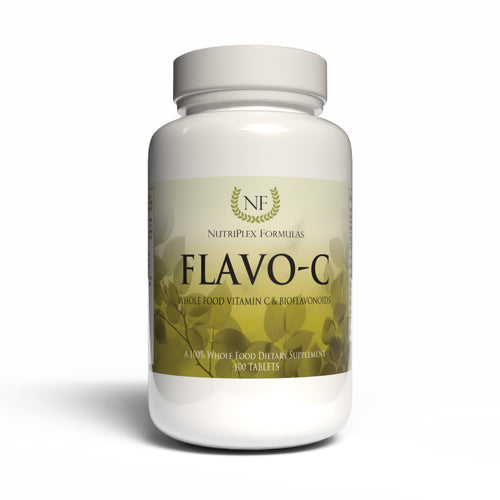
Camu is a small berry from the Amazonian rainforest. It contains one of the highest concentrations of vitamin C found in any food, roughly 30 to 50 times more vitamin C than an orange, depending on growing conditions and the part of the fruit analyzed. Beyond its ascorbic acid content, camu contains anthocyanins, flavonoids, amino acids, and other nutrients. This is one of the primary ingredients in Flavo-C.
Acerola cherry has a vitamin C concentration roughly 10 to 50 times higher than oranges, varying by variety and ripeness. What I find equally important is the breadth of nutrients contained within it. Acerola holds magnesium, pantothenic acid, potassium, vitamin A, thiamin, riboflavin, niacin, calcium, protein, iron, phosphorus, and limonene, along with anthocyanins, catechins, kaempferol, carotenoids, and other flavonoids. These exist not as individual nutrients but as part of the whole food complex that nature provides. This is the kind of nutrient profile you simply don't get from a synthetic source.
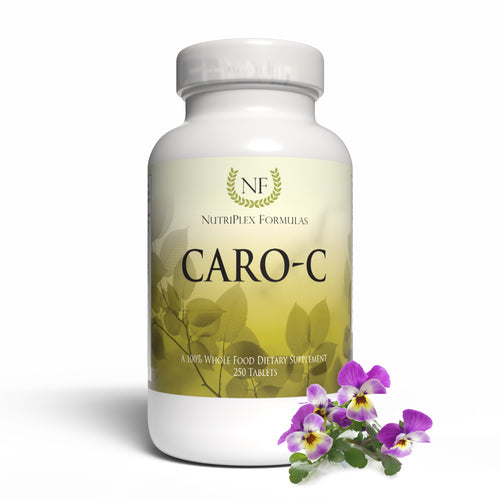
Acerola is an ingredient in both Flavo-C and Caro-C.
Rose hips, the seed pods of the rose plant, are less commonly discussed but valuable. They contain vitamin C alongside carotenoids, vitamin E, flavonoids, and minerals. Some of the earliest documented observations about natural vitamin C included rose hips, and they remain one of the more nutritionally complete whole foods available. Most people aren't sourcing rose hips on their own, and concentrated whole food ingredients like this are exactly why whole food vitamin C formulas exist in the first place.
These three whole foods differ from vitamin C supplements on the market in one fundamental way: the vitamin C is inherent to the plant, not introduced to it afterward as a lab-made chemical.
Questions I Hear Most About Vitamin C Supplements
Is ascorbic acid the same as vitamin C?
Ascorbic acid is a component of the vitamin C complex, but not the whole thing. In whole foods, ascorbic acid is accompanied by bioflavonoids and other plant nutrients. Most supplements contain ascorbic acid alone, without those accompanying nutrients. So an isolated ascorbic acid pill and the vitamin C found in whole foods are related, but they are not the same.
Is whole food vitamin C better absorbed than ascorbic acid?
Some studies suggest that bioflavonoids within nature's whole foods affect how vitamin C behaves in the body. The cofactors in these foods have their own biological activity, supporting capillary health, protecting ascorbic acid from oxidation, bolstering the immune system, aiding in calcium efficacy, and so on, which isolated ascorbic acid supplements do not have the power to create. Absorption can be a misleading word, because even toxins are absorbable. What’s important is whether the nutrient is in fact still contained within its original food!
How do I know if my vitamin C supplement is really whole food?
Look at the ingredient list, not the front label. If the primary vitamin C listing is "ascorbic acid" or "vitamin C (as ascorbic acid)," it's synthetic, regardless of other language on the packaging. A genuine whole food product names the actual plant (acerola cherry, camu, rose hips, and the like) as the origin of the vitamin C.
Can high-dose ascorbic acid affect mineral balance?
Some research has found that high-dose supplemental ascorbic acid may affect copper levels, specifically ceruloplasmin, a copper-carrying protein involved in enzyme function and iron metabolism. These effects appear to be dose-dependent, and the evidence is still debated in the scientific literature. Side effects like this are relatively unheard of, or far less commonly associated with vitamin C from whole foods. Taking high doses of any supplement isn't natural to do, because the amounts of vitamins in nature's real foods do not exist in high doses. Corporate scientists and the pharmaceutical industry that make most vitamins focus on creating a biochemical reaction, and they are not intending to deliver what is truly in concert with the body.
What foods have the highest whole food vitamin C?
Camu, acerola cherry, amla berries, and rose hips are among the most abundant whole foods for vitamin C, well ahead of citrus. Guava, kiwi, bell peppers, and dark leafy greens are also meaningful, and they are foods most people can easily work into a diet. Camu, acerola, and rose hips are a different story, because most people aren't eating them on their dinner plates, which is exactly why we include them in our whole food vitamin C formulas.
Why do some "whole food" supplements still contain ascorbic acid?
This is misleading and represents a case of mixing foods and isolated chemicals together and then referring to the mixture as a whole food. It’s disingenuous. Several supplement companies use synthetic ascorbic acid as their primary ingredient and introduce it to a food substrate, then market the result as "whole food" or "food-grown" vitamin C. The ascorbic acid is still synthetic. The food material is added into the mix. The label language sounds like whole food nutrition, but the underlying ingredient often isn't. Reading the actual ingredient list, not just the front panel, is the only reliable way to tell the difference. Some manufacturers also spike their whole foods with ascorbic acid so that it seems like they are delivering more natural vitamin C than they actually are.
Is ascorbic acid safe?
For most people, at typical supplemental amounts, ascorbic acid is generally considered safe. I'm not arguing that ascorbic acid is necessarily harmful. My position is that it’s not a food and therefore not natural. An isolated vitamin C ascorbic acid isn't equivalent to vitamin C still contained in its original whole food complex, and choosing a whole food gives your body access to a broader range of nutrients that naturally, not artificially, work alongside the ascorbic acid. The question isn't primarily about safety. It's about what you're actually feeding your cells.
What's the difference between acerola and ascorbic acid?
Acerola is a whole food, a cherry with a naturally high concentration of vitamin C and other nutrients. This is the way nature packages it, within the food where the vitamin is found. When you take acerola as a supplement, you're getting a food that contains ascorbic acid along with the bioflavonoid complex, carotenoids, minerals, and other nutrients that are contained in the plant. Ascorbic acid alone is a single isolated molecule, produced industrially, without any accompanying nutrients. One is a complete nutritional package. The other is a single extracted non-food component of it.
The Bottom Line

After more than 30 years in this field, I've watched the supplement industry get more sophisticated, and more manipulative, in its language while often being less honest about what's actually in the bottle. "Whole food vitamin C" is a phrase that carries real meaning, but only when the vitamin C comes from natural, organically grown (or better) whole foods.
The distinction between an ascorbic acid isolate and the full vitamin C complex isn't a minor technicality. It's the difference between a single isolated molecule, a chemical that is not found in nature, and the complex nutrient system that exists within nature's foods. Bioflavonoids protect ascorbic acid within a food from oxidation. They support capillary integrity and collagen production. They contribute to the body's immune response in their own right. All of this is absent from isolated ascorbic acid, regardless of what the front label says.
When I formulate a supplement I start with a nutrient dense food and then look carefully to avoid its potential side effects. I err on the side of caution and have to offer a product that is safe as well as effective. I consider foods such as camu, acerola cherry, rose hips, and others because they carry the vitamin C complex and an abundance of bioflavonoids and other helper nutrients that can only be found in nature. The goal isn't to deliver the highest number of milligrams possible that look impressive on a label. It's to give the body something it can recognize, use, and process. And it remains a secret to most people that more is not necessarily better. Quality and nutrient density come first and foremost.
If you're looking at your vitamin C supplement right now, turn it over and read the ingredient list, not the front panel, not the marketing copy. If it says "ascorbic acid" without a whole food plant listed as the origin of that vitamin C, you're taking a synthetic isolate. The label claim of "natural" or "whole food" may not mean what you hope it does.
If nature matters more to you than laboratory-made chemicals, and you know how to read what's on the label, the choice is clearer.
Products Mentioned in This Article

These statements have not been evaluated by the Food and Drug Administration. This product is not intended to diagnose, treat, cure, or prevent any disease.
